A Free Brain Dump Template (and How to Actually Use It)
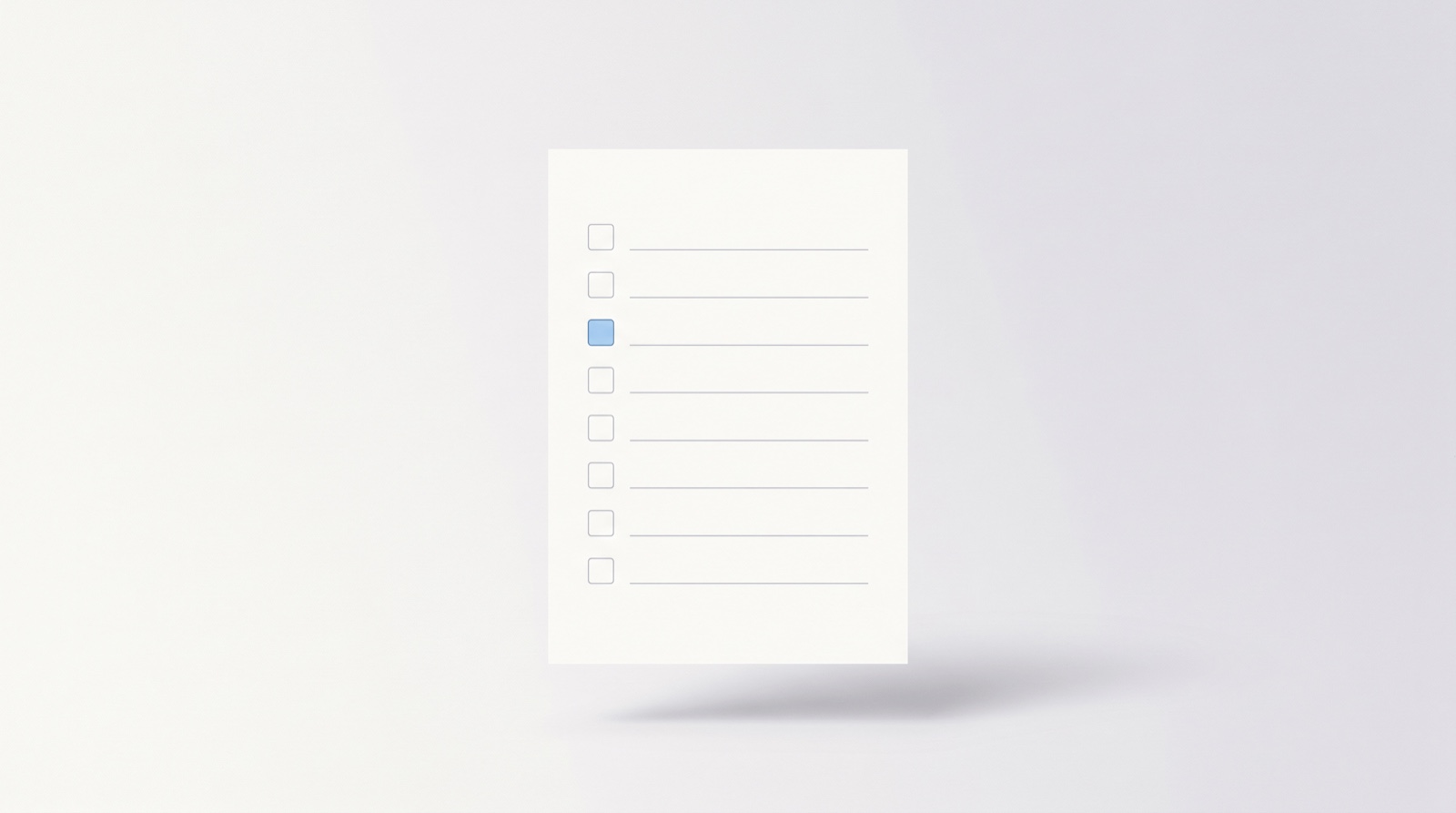
A brain dump template is a simple, repeatable structure for emptying your head onto a page: a space to dump everything first, then a light way to sort it after. You can copy the free one below and use it on paper or in any note. The trick is keeping capture and sorting separate, so the template helps you think instead of asking you to organize while your head is still full.
The template, at a glance
- What it is: three short parts, dump, sort, then plan, on one page.
- What you need: a blank page or note. No app or printable required.
- How long: five to ten minutes to dump, a few more to sort.
- The one rule: capture everything first, sort it only after. Never do both at once.
- What makes it work: end with one item that has a time and a place, not a wall of notes.
A free brain dump template (copy this)
Here is the template. Write it on paper, print this page, or paste it into any note, then work through it from the top.
Brain dump, [today’s date]
1. Dump it all (five to ten minutes, any order, no editing). Write every task, worry, and half-formed idea as it arrives. If you stall, answer one prompt to get going:
- What am I afraid I will forget?
- What have I been avoiding?
- Who am I waiting on, and who is waiting on me?
- What did I promise someone?
- What keeps interrupting me when I try to focus?
2. Sort it (only once the page feels quiet). Put each item in one bucket:
- Today: the one to three that truly matter
- This week: soon, but not now
- Someday or maybe: park it without guilt
- Not mine: delegate it, drop it, or let it sit
3. Plan the top one. Give today’s most important item a time and a place: “I will [do the thing] at [time], in [place].”
That is the whole template. The structure is deliberately thin, because the value is in the order: dump, then sort, then plan. The next three sections explain why each part works.
Phase one: dump everything, no sorting
Start by getting it all out, in any order, with no categories. Your working memory can only hold a handful of things at once, roughly four on a good day (Cowan, 2001), so let the page do the remembering for you. Resist the urge to file each thought as it lands. Sorting while you capture means switching between two different mental jobs, and every switch carries a small cost in time and accuracy that adds up fast (American Psychological Association).
The prompts in the template are there only if you stall. They work as retrieval cues, and a good cue pulls up items you would not have reached on a blank page. In a classic memory experiment, people recalled far more when given simple cues than when asked to remember the same material unaided (Tulving and Pearlstone, 1966). Answer whichever prompt tugs at you, then keep going until the page feels quiet.
Phase two: sort what you dumped
Once it is all out, and only then, start sorting. Group what belongs together and drop each item into one of the four buckets in the template: today, this week, someday, or not mine. Sorting is about finding the one to three things that truly matter today and letting the rest wait somewhere you trust. A dump on its own can feel almost as heavy as the noise it came from. The relief lives in this second half, when the pile becomes a short, clear shortlist.
Keep the “not mine” bucket honest. Plenty of what lands in a dump belongs to someone else, or to no one. Naming what you can delegate, drop, or simply leave alone is often the fastest way to make the page lighter.
Phase three: give the top item a time and a place
Finish by turning today’s most important item into one concrete next step with a when and a where. This is the part that quiets the noise. Unfinished tasks keep nagging until you decide what to do about them, and you do not have to finish one to settle it. Across a series of experiments, simply making a concrete plan for an unresolved task reduced the intrusive thoughts it was causing (Masicampo and Baumeister, 2011).
A plan is also far likelier to happen when it names a moment and a place, what psychologists call an implementation intention (Gollwitzer, 1999). Pooling 94 studies, people who set these “I will do X at this time, in this place” plans reached their goals at meaningfully higher rates than people who set the goal alone, a medium to large effect (Gollwitzer and Sheeran, 2006). In practice, “I will book the dentist at 9am from my desk” beats “book dentist.”
Why a template helps, and when it gets in the way
A template helps because it carries the structure for you, so a tired mind does not have to reinvent the method every time. That is the same reason checklists work in high-stakes places. A 19-item surgical safety checklist, tested across eight hospitals, cut complications from 11.0% to 7.0% and deaths from 1.5% to 0.8%, by making sure trained teams completed every known step, even the ones easy to skip under pressure (Haynes et al., 2009). A brain dump is far lower stakes, but the principle holds: a light structure catches what a busy head drops.
The catch is that a template can backfire when it asks you to file thoughts into labeled boxes while you are still capturing. That quietly reintroduces the switching cost the dump is meant to avoid. So the template above keeps phase one wide open, with prompts as optional nudges rather than categories, and saves every bucket for phase two. Elaborate systems like the bullet journal can work too, though they ask you to learn symbols and keep collections, which is more upkeep than a dump needs. Start plain, and add structure only if you find yourself missing it. If a template ever makes capture feel slower, strip it back to a single blank space.
Daily, weekly, and work versions
The same three-part shape flexes to fit the moment. A few variations of the brain dump worksheet:
- Daily brain dump: the template above, set to five minutes. It works well as a morning sweep to set the day, or an evening one to put the day down.
- Weekly brain dump: widen the prompts to the whole week. What is due, who am I waiting on, what is coming that I have not prepped for. Sort into this week and next, then pick the top item for each day.
- Work brain dump: capture open loops, things you are waiting on, and anything you are holding for someone else. The “not mine” bucket matters most here, so name what to hand back or delegate.
A brain dump template for ADHD
If your head often has too many tabs open, the same template fits, with two small tweaks from ADHD coaching. Start each sorted item with a verb so it tells you what to actually do, and batch similar items together so you switch gears less. Working memory and getting started are exactly the executive functions ADHD tends to tax (CHADD), which is why moving thoughts out of your head and onto a trusted page helps so much (ADDitude). There is a fuller, ADHD-tuned version in the ADHD brain dump method.
Do it on paper, or let an app run the loop
The template works on paper or in any note, and that is a fine place to start tonight. The one weak point of paper is the second half. A dump only stays calming if you trust you will come back to it and act, and a sheet of paper cannot remind you. That follow-through is the part Whit is built around.
Whit is a calm brain dump and daily planner for iPhone, iPad, and Mac that runs this exact loop for you. You capture by text or voice, one thought per line with no list or due date required, and it lands in a Calm Inbox instead of a pile of red badges. That is phase one, without the friction. When you are ready, you turn those captures into a Visual Day, a gentle timeline from sunrise to night, so phases two and three happen in one move: the dump becomes a plan with a real time, rather than a longer list you owe.
Your dump stays private by design. Whit syncs only through your own iCloud, with no accounts, no logins, and no analytics in the app, so what you empty out of your head stays yours. You can see everything Whit does or read how it compares to Todoist.
One honest note: brain dumping as a named technique has not been tested on its own in a controlled trial, and Whit is a calm productivity tool rather than a medical or mental-health treatment. The support here comes from well-established research on working memory, planning, and retrieval, so it is fair to treat the template as a sensible, low-cost habit.
Related reading
- New to the idea? Start with what a brain dump is and how to do one.
- Want a tool to do it in? See the best brain dump app for iPhone, iPad, and Mac.
- Have ADHD? Read the ADHD brain dump method.
Where to start
Copy the template tonight, set a timer for five minutes, and empty your head onto one page. Tomorrow, sort it, pick one item, and give it a time and a place. Notice how much quieter your head feels once it all lives somewhere you trust.
If you want that somewhere to remember it for you, Whit is a one-time purchase for iPhone, iPad, and Mac, with a 7-day free trial, then $99 once with no subscription. See the details.