From Brain Dump to Daily Plan in 10 Minutes
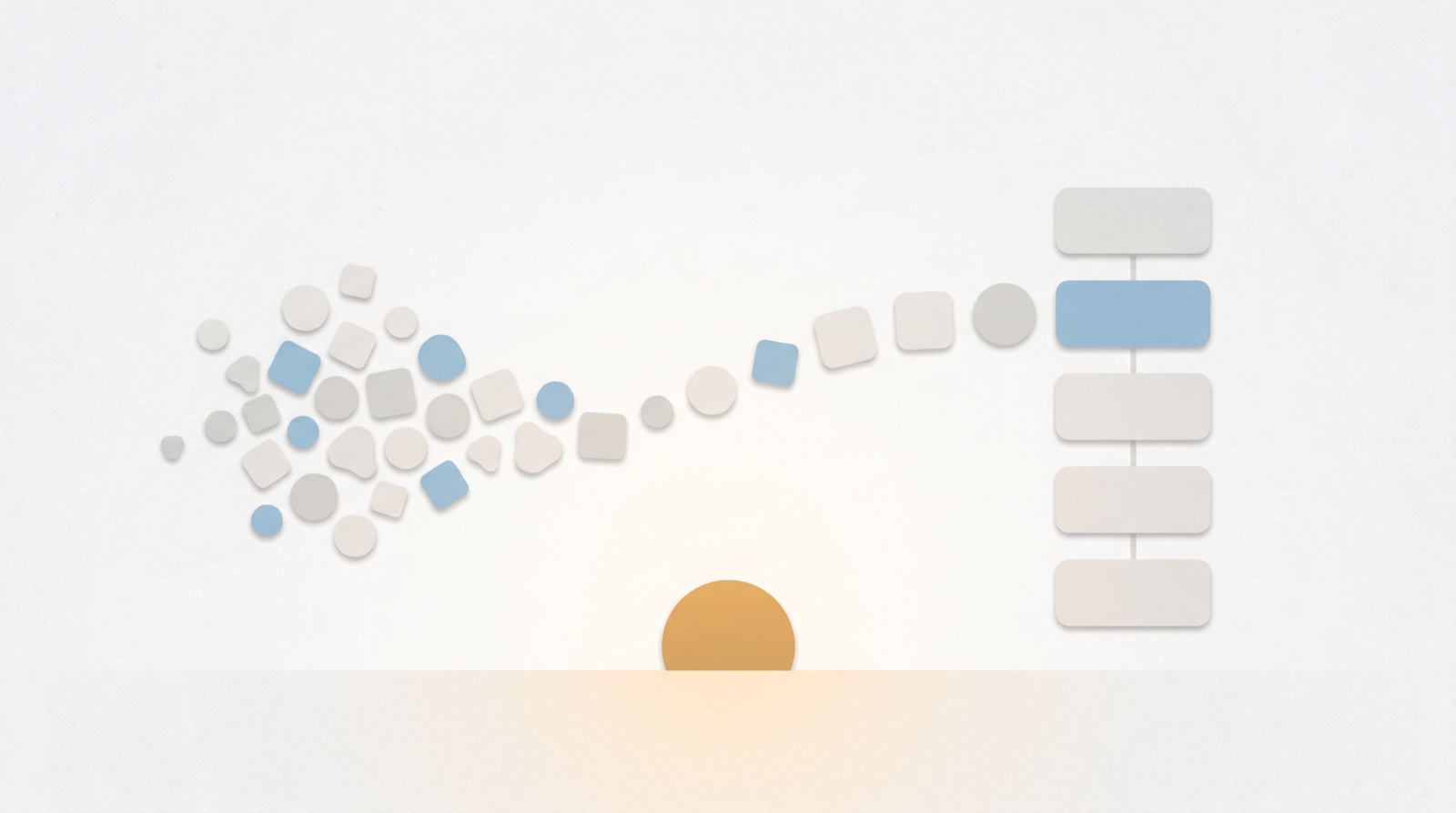
A brain dump empties your head. A daily plan is the second half, the part that actually calms you, and it takes about ten minutes. To turn a brain dump into a daily plan, you sort the pile, pick one to three things that matter today, and give each a real time and place. The list becomes a day you can live instead of a wall of everything you owe.
The ten-minute plan, at a glance
- Start from: a finished brain dump, every task and worry already out of your head.
- What you do: sort, pick a few, then schedule them onto a timeline.
- How long: about ten minutes, once a day.
- The one rule: plan fewer things than you think you can do, and give each a time.
- What you end with: one to three items, each with a when and a where, and gaps left on purpose.
How to turn a brain dump into a daily plan
Work top to bottom. If you have not dumped yet, do that first; here is how to do a brain dump. Once it is all on the page, this is the loop:
- Empty your head (2 min). Add anything still rattling around. You cannot plan around a task that is hiding in your memory.
- Cross off and park (2 min). Delete what does not matter, hand back what is not yours, and move anything that can wait to a “this week” or “later” list you trust. Most of a dump is not for today.
- Pick one to three (1 min). Choose the few that would make today feel like progress. Resist the urge to keep the whole list “just in case.”
- Give each a time and a place (3 min). Write “I will reply to the landlord at 9am at my desk,” not “reply to landlord.” A when and a where is what makes a plan happen.
- Lay it on a timeline, leave gaps (2 min). Put your picks on the day in order, with real space between them. A day with gaps survives contact with reality; a packed one falls apart by noon.
That is the whole method. The sections below explain why each step is doing real work, so you can trust the order even on a tired morning.
The plan, not the dump, is what calms you
A dump on its own can feel almost as heavy as the noise it came from. The relief lives in deciding what happens next. Unfinished tasks keep nagging until you settle them, and the encouraging part is that you do not have to finish a task to quiet it. Across a series of experiments, simply making a concrete plan for an unresolved task reduced the intrusive thoughts it was causing (Masicampo and Baumeister, 2011). So the calm you are after arrives the moment each thing that matters has a clear next step, well before the list itself is finished.
This is why a dump you never plan tends to stop working after a while. The page fills, but the loops stay open. Turning the pile into a few scheduled steps is the move that actually lets your head put it down.
Pick one to three things, not ten
Choose a tiny number on purpose, because your day has less room than your optimism thinks. People reliably underestimate how long their own tasks will take, even when they know their track record. In one well-known study, students predicted their thesis would take about 34 days. It took closer to 56, and only about a third finished by the date they had predicted (Buehler, Griffin, and Ross, 1994). A ten-item plan is that same optimism, multiplied across a single morning.
There is a memory limit underneath it too. The part of your mind that holds active thoughts can keep only a handful of things in focus at once, roughly four under careful testing (Cowan, 2001). A plan you cannot hold in mind is one you will keep re-reading instead of doing. One to three real priorities is plenty. It is a plan that fits the day, and the head it has to live in.
Give each one a time and a place
The difference between a wish and a plan is a when and a where. Naming the moment and the spot is what psychologists call an implementation intention, and it reliably lifts follow-through. Pooling 94 studies, people who set “I will do X at this time, in this place” plans reached their goals at meaningfully higher rates than people who set the same goal without one, a medium to large effect (Gollwitzer and Sheeran, 2006). The original work traces the effect to how a specific cue, a time or a place, hands the start of the task over to your surroundings instead of your willpower (Gollwitzer, 1999).
This is also the honest case for time-blocking, the habit of giving each task a slot rather than leaving it on an open list (Harvard Business Review). A block works when you treat it as a real “at 2pm, at my desk, I open the document” commitment, not a vague suggestion you renegotiate all day. In practice, “book the dentist at 9am from my desk” beats “book dentist,” every time.
Leave gaps on purpose
A good daily plan is mostly empty. Because you will underestimate every task (Buehler, Griffin, and Ross, 1994), the fix is to schedule less than feels right and leave real space between blocks. The gaps catch the overruns, the interruptions, and the things you forgot.
Spacing also lets you do one thing at a time, which is faster than it sounds. Every time you switch between tasks you pay a small cost in time and accuracy, and those costs add up across a choppy day (American Psychological Association). A plan with room lets each block finish before the next one starts, so you are working, not juggling.
If you have ADHD
The same ten minutes work, with two tweaks, because time itself is harder to feel when your head has too many tabs open. Time estimation, working memory, and getting started are exactly the executive functions ADHD tends to tax (CHADD), which is why a plan that lives outside your head, with the time written down, helps so much (ADDitude). First, double your time estimates rather than trim them, since the planning gap tends to be wider here. Second, make the first step almost embarrassingly small and physical: “open the document and write one sentence,” not “write the report.” There is a fuller, ADHD-tuned walkthrough in the ADHD brain dump method.
How Whit turns the dump into your day
This whole loop, capture then plan, is what Whit is built to run. Whit is a calm brain dump and daily planner for iPhone, iPad, and Mac. You capture whatever is on your mind by text or voice, one thought per line, and it lands in a Calm Inbox instead of a pile of red badges. That is the dump, without the friction.
When you are ready, you turn those captures into a Visual Day, a gentle timeline that runs from sunrise to night. The planning step happens in one move: you drop a few picks onto the day, each at a real time, and the gaps stay visible so you can see whether the day actually fits. That is the part the research keeps pointing to, since deciding when something will happen is what quiets it.
Your dump stays private by design. Whit syncs only through your own iCloud, with no accounts, no logins, and no analytics in the app, so what you empty out of your head stays yours. You can see everything Whit does or read how it compares to Todoist.
One honest note: brain dumping as a named technique has not been tested on its own in a controlled trial, and Whit is a calm productivity tool rather than a medical or mental-health treatment. The support here comes from well-established research on working memory, planning, and intentions, so it is fair to treat this ten-minute routine as a sensible, low-cost habit.
Related reading
- New to the idea? Start with what a brain dump is and how to do one.
- Want a structure to reuse? Copy the free brain dump template.
- Looking for a tool to do it in? See the best brain dump app for iPhone, iPad, and Mac.
Where to start
Tonight or first thing tomorrow, set a ten-minute timer. Empty your head, cross off and park, pick one to three, and give each a time and a place. Notice how different the day feels when it is a short, real plan instead of a long, hopeful list.
If you want a place that holds the dump and lays out the day for you, Whit is a one-time purchase for iPhone, iPad, and Mac. There is a 7-day free trial, then $99 once with no subscription. See the details.