How to Prioritize Tasks When Everything Feels Urgent
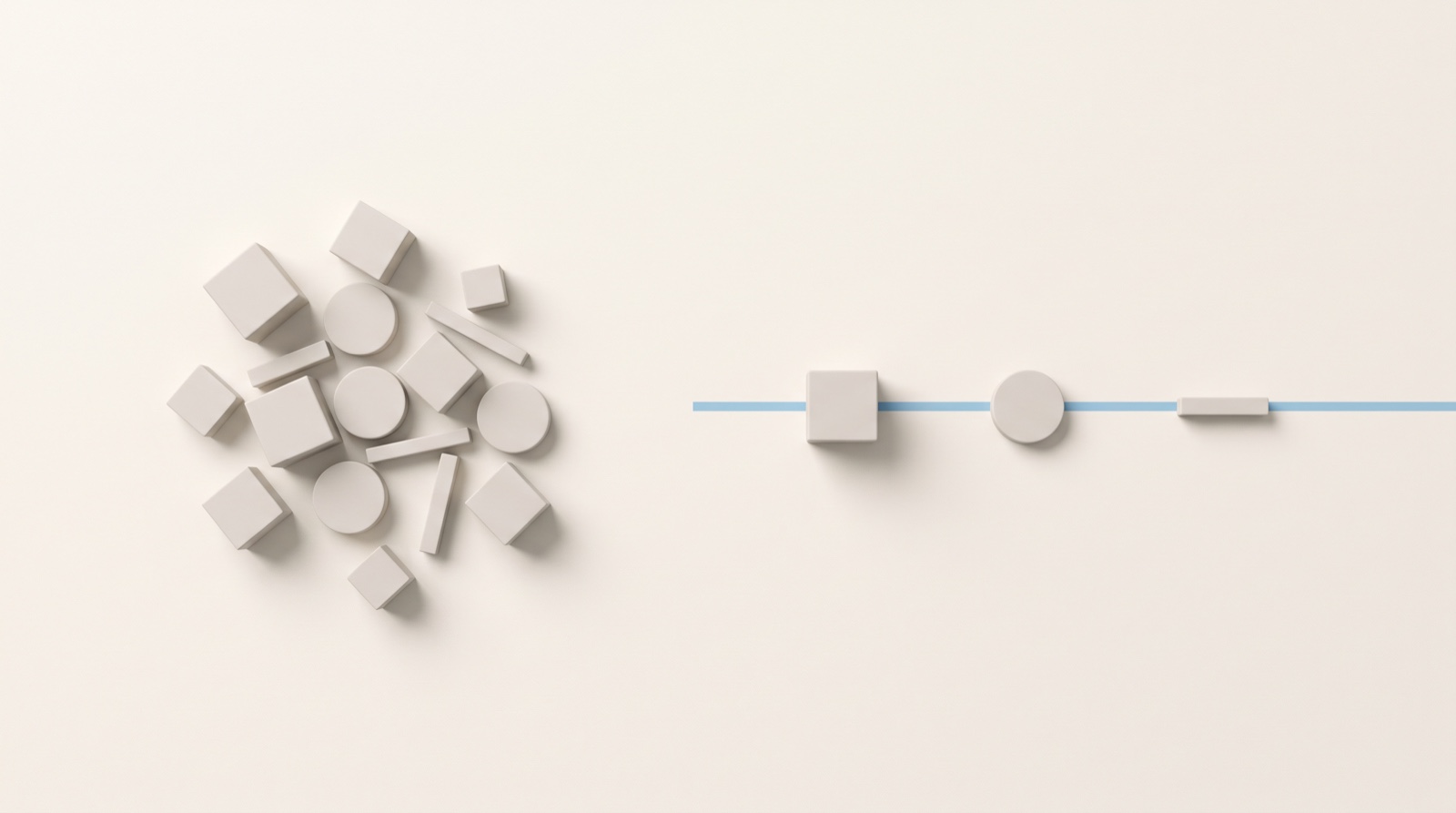
To prioritize tasks well, get everything out of your head first, then judge each item by what it is worth rather than by how soon it expires, pick a number that fits the day, and give the few you chose a specific time and place. The hard part comes before the ranking, in noticing that a deadline is a different thing from a payoff, and that your attention will confuse the two unless you make it look at both.
Here is the whole method before the detail.
| Step | What you do | Why it earns its place |
|---|---|---|
| 1. Empty | Write every open loop down, unsorted | You cannot rank a list you are still trying to remember |
| 2. Separate | Mark what carries real weight, before you look at any due date | Urgency hijacks the choice when it is the only thing visible |
| 3. Size | Ask how long each one really took last time | Your estimate of your own capacity is optimistic, reliably |
| 4. Cut | Choose the few that fit the hours you have | A list longer than the day is a ranking that has not happened yet |
| 5. Plan | Give each chosen item a when and a where | This is the step with the strongest evidence behind it |
Why urgent work keeps beating important work
Your priorities drift for a structural reason rather than a moral one. A deadline is easier to see than a payoff, and attention follows what is visible.
This has a name and a careful set of experiments behind it. Meng Zhu, Yang Yang, and Christopher Hsee call it the mere urgency effect: people choose tasks that expire sooner even when a competing task is worth more and there is plenty of time to do either one (Zhu, Yang, and Hsee, 2018). In one experiment, participants chose between a task paying 12 cents and one paying 16 cents. When both had a comfortable 50-minute window, 7.3 percent picked the worse-paying task. When the worse-paying task was given a five-minute window instead, that rose to 48.1 percent. Nothing about the money changed. Only the clock did.
The researchers tracked where attention went, and that is the useful part. Urgency pulled attention toward the expiration and away from the payoff. The effect was also stronger in people who perceived themselves as busy, which is an uncomfortable finding if you are reading this because your week is full.
One experiment points straight at the fix. When the payoffs were simply repeated to participants immediately before they chose, the gap between the urgent and non-urgent conditions shrank to nothing (Zhu, Yang, and Hsee, 2018). Being reminded what each option was worth, at the moment of choosing, was enough. That is the entire argument for a deliberate prioritizing step: not because ranking is magic, but because it forces the payoff back into view while you decide.
Worth being straight about the limits. These were short, artificial tasks in a lab, worth cents. Applying the finding to a quarter-long project is a reasonable inference rather than a demonstrated result.
How to prioritize tasks, step by step
A pen and one sheet of paper is enough. Nothing here needs software.
Step 1: Empty your head before you rank anything
Write down everything you are carrying, unsorted and unjudged. Work, errands, the message you owe someone, the vague thing you keep half-remembering at traffic lights. Writing it down moves the load off your memory and onto the page, which is what psychologists call cognitive offloading (Risko and Gilbert, 2016). Experiments on external reminders find that people fulfil more of their intentions when they set them down outside their own heads, especially under heavier memory load (Gilbert, 2015).
Ranking while still holding the list in memory means re-reading the same six worries in a loop. Get it out first. If you have never done this deliberately, what a brain dump is walks through it slowly.
Capturing an item is not the same as committing to it. The page is a holding area, not a promise.
Step 2: Judge importance before you look at deadlines
Go through the list once and mark what matters, using a question about consequence rather than timing. A good one: if this were the only thing I finished this week, would the week have been worth something? Another: what happens if this never gets done?
Do this pass with the due dates covered over, in your head or on the page. The research above is clear that when urgency is the visible feature, it wins (Zhu, Yang, and Hsee, 2018). Looking at worth first, on its own, is the practical translation of the one manipulation that neutralized the effect.
Then bring deadlines back in. Some urgent things are also important, and some have to happen today regardless of their weight. The point is that they earn their place by both measures rather than by the clock alone.
Step 3: Estimate with your history, not your optimism
Before choosing what fits today, ask how long each item took the last time you did something comparable.
People are consistently and specifically optimistic here. When Roger Buehler, Dale Griffin, and Michael Ross asked students to predict when they would finish their thesis, the average prediction was 33.9 days and the average reality was 55.5 days. Only about 30 percent finished by their own predicted date, and actual completion came later than the average worst-case estimate they had given (Buehler, Griffin, and Ross, 1994). The same paper found the correction: prompting people to connect their prediction to relevant past experience removed the bias.
So the useful question shifts from “how long should this take” to “how long did the last one take.” Your history knows things your optimism does not.
Step 4: Cut the list to what the hours allow
Now choose. Not a ranked list of everything, just the few that fit the time left after meetings, travel, and interruptions.
You will see a specific number recommended everywhere: three tasks, or the 1-3-5 rule, or six in the Ivy Lee version. It is worth knowing that none of those numbers has been tested. No controlled study shows that exactly three beats two or five, and the fact that the popular methods disagree about the number is itself a hint that it is convention rather than a discovered limit. Choose by capacity instead: what fits the hours, given step 3.
What is well supported is that the rest of the list can stay written down and unchosen. Deciding an item is not for today is a real decision, and it counts.
Step 5: Give each chosen task a when and a where
This is the step with the strongest evidence of any in the method, and the one most often skipped.
An implementation intention is a plan in the form “if it is 9am and I am at my desk, then I will open the budget file.” A meta-analysis of 94 independent tests covering 8,461 participants found these plans produced a medium-to-large improvement in goal attainment, around d = .65, with the effect showing up both in getting started and in not getting derailed (Gollwitzer and Sheeran, 2006). About half the studies included were unpublished, which makes the result harder to dismiss as a publication artifact.
There is a second benefit that matters if your head will not go quiet. Masicampo and Baumeister found that unfinished goals produced intrusive thoughts and measurably interfered with unrelated tasks, and that making a specific plan removed the interference even though the task itself remained undone (Masicampo and Baumeister, 2011). In one of their studies, people solved 6.55 anagrams after an unfulfilled goal and 9.55 after planning it. A task with a time stops interrupting you. It does not need to be finished first.
Naming a first action helps here too. “Do taxes” has no obvious opening move, so it will sit. “Open the folder and find last year’s return” has one.
The named methods, rated on their evidence
Most prioritization advice arrives wrapped in a confident origin story. Several of those stories do not survive checking, and none of the branded systems has controlled evidence behind it. That does not make them useless. It makes them heuristics, which is a fine thing to be as long as nobody is selling them as science.
| Method | Where it comes from | Evidence | Worth using when |
|---|---|---|---|
| Eisenhower matrix | Eisenhower did say the urgent/important line in 1954, but he introduced it as a quote from an unnamed former college president, and never drew a matrix (1954 transcript). Stephen Covey formalized the four quadrants in The 7 Habits of Highly Effective People (1989) | No controlled outcome evidence for the matrix itself. Its core premise is supported indirectly by the urgency research above | You need to see, once, how much of your week sits in urgent-but-unimportant |
| ABCDE | Brian Tracy’s version in Eat That Frog!, extending Alan Lakein’s older A/B/C system from 1973 | Self-help provenance, no controlled trials | You want a fast single pass over a long list |
| Ivy Lee method | Six tasks, ranked, the night before. The famous story of Charles Schwab paying $25,000 in 1918 has no contemporary paper trail; the earliest tellings appear decades later, and they disagree with each other | Business legend, not a documented experiment. No outcome evidence | You want a simple end-of-day ritual and do not mind the number six being arbitrary |
| MoSCoW | Fully traceable: Dai Clegg and Richard Barker, CASE Method Fast-Track (1994), for timeboxed software delivery | Real provenance, but little evidence of improved outcomes, and none for personal task lists | You are scoping a project with other people, which is what it was built for |
| RICE | Sean McBride at Intercom, 2018. Reach times Impact times Confidence, divided by Effort | No independent validation. It produces a number out of four estimates, which can look more objective than it is | You are comparing similar product initiatives, not daily tasks |
| 1-3-5 and MITs | The Muse popularized 1-3-5; Leo Babauta popularized MITs and said plainly that it was “not an original concept” | No test of the ratios or of the number three | You want a cap on the day and are honest that the number is a convention |
The parts of these methods that do have evidence are the parts they share: separating worth from deadline, and converting a chosen task into a concrete plan. Pick whichever wrapper you will use.
What the evidence does and does not support
A few honest notes, because this topic attracts confident claims.
A long list is not draining a battery. You will often read that too many choices cause decision fatigue, resting on the idea of a finite pool of willpower. That specific mechanism has held up badly: a preregistered replication across 23 labs, with 2,141 participants, found an effect indistinguishable from zero (Hagger et al., 2016). Long lists can be hard to compare across, which is a different and more modest claim.
Choice overload is conditional, not a law. The famous jam study is real: 30 percent of shoppers who stopped at a six-jam display bought, against 3 percent at a 24-jam display (Iyengar and Lepper, 2000). A later meta-analysis of 50 experiments and 5,036 participants found an average effect of essentially zero, d = .02, with wide variation by context (Scheibehenne, Greifeneder, and Todd, 2010). The current synthesis is that overload appears when options are hard to compare and the chooser is unsure what they want (Chernev, Böckenholt, and Goodman, 2015), which does describe a messy task list, though that application has not been tested directly.
The strong evidence is about planning, not ranking. Implementation intentions have a large, well-replicated literature behind them (Gollwitzer and Sheeran, 2006). Prioritization frameworks do not. If you only adopt one step from this post, make it step 5.
Time-management research is modest. Reviews find planning and prioritizing are associated with feeling more in control of your time and somewhat less strained, but the evidence is mostly correlational and the effects on actual performance are unclear. This is a low-cost habit that tends to help, not a guarantee.
Prioritizing when you have ADHD
If ranking a list is where things reliably fall apart for you, that is a recognized difficulty rather than a character flaw. CHADD names “organizing, prioritizing, and activating for tasks” as one cluster of executive function, alongside sustaining attention, regulating emotion, and working memory (CHADD). Barkley and Murphy found that everyday executive-function ratings predicted impairment across all 11 measures of occupational adjustment they examined, and predicted real-world functioning better than lab tests did (Barkley and Murphy, 2010).
Worth saying that comparatively little research isolates prioritization decisions specifically, and no study has tested the Eisenhower matrix or ABCDE in an ADHD population. What follows is practitioner advice, offered as such.
ADDitude recommends keeping a comprehensive long list separate from a short list of what genuinely must happen today, and rereading the short one after every interruption rather than trying to hold it (ADDitude). Two things follow from that. Keep the choosing and the doing apart, so you are not re-ranking mid-task. And put the short list somewhere visible, because an externalized decision survives a distraction in a way a remembered one does not.
If the choosing itself is where you freeze, that is a different problem with a different fix, and task paralysis covers it. If everything is arriving at once and ranking feels beside the point, start with ADHD overwhelm instead.
How Whit fits
The two steps with real evidence behind them, getting it all out of your head and giving the few that matter a specific time, are the loop Whit runs. Whit is a calm brain dump and daily planner for iPhone, iPad, and Mac.
Capture comes first, by text or voice, into a Calm Inbox with nothing to categorize at the moment of catching a thought. That keeps step 1 cheap, which matters, because a capture step you dread is a capture step you skip. Nothing in the inbox is a commitment yet, which is the distinction the whole method rests on.
Then the Visual Day is where step 5 happens. The few things you chose sit on a gentle timeline from sunrise to night, so a plan is a place on a real day rather than another line on a list. The timeline also makes step 4 honest, since it is immediately obvious when you have assigned more work than the hours can hold. From brain dump to daily plan walks through the handoff.
What Whit deliberately does not do is add urgency. There are no red overdue badges and no streak pressure, because manufactured deadlines are exactly the signal the research says will hijack your ranking. What you write stays yours, synced only through your own iCloud, with no accounts, no logins, and no analytics in the app.
Common questions about prioritizing tasks
What is the best way to prioritize tasks?
Separate importance from urgency, then convert your choices into concrete plans. Judge each task by what it is worth before you look at its deadline, cut the list to what your hours can hold, and give each survivor a specific time and place. The planning step has the strongest research behind it (Gollwitzer and Sheeran, 2006).
Why do I always do the urgent tasks instead of the important ones?
Because deadlines are more visible than payoffs, and attention follows what it can see. Zhu, Yang, and Hsee showed that a short expiry window pulled people toward objectively worse-paying tasks, and that simply restating what each option was worth right before choosing removed the effect (Zhu, Yang, and Hsee, 2018).
Does the Eisenhower matrix work?
It is a useful thinking tool with no controlled evidence behind it. Eisenhower quoted the urgent-versus-important distinction in 1954 but never drew a matrix; Stephen Covey formalized the quadrants in 1989. The underlying premise that urgency distorts choice is supported by separate research, though that does not validate the four boxes or their prescriptions.
How many tasks should I put on my daily list?
As many as your available hours can hold, which is usually fewer than it feels. The popular numbers, three tasks or the 1-3-5 rule or Ivy Lee’s six, are conventions rather than findings, and no study has tested them. Estimating from how long comparable work took is more reliable than any fixed count (Buehler, Griffin, and Ross, 1994).
What should I do with everything I did not choose?
Leave it written down and unscheduled. Items you have captured but not committed to are not being neglected, and an unfinished task stops interrupting you once it has a plan rather than once it is done (Masicampo and Baumeister, 2011). Review the long list at a set time so it stays trustworthy.
Related reading
- The capture step in full: what a brain dump is.
- Fitting your picks into an actual day: how to plan your day.
- The one-task version of this: eat the frog.
- When you cannot start the thing you ranked first: task initiation.
- When the invisible list is the problem: the mental load.
- Building the list you rank from: how to make a to-do list.
Where to start
Try the cheap version tonight. Write down everything you are carrying, mark what is worth doing before you look at a single due date, ask how long the last comparable task really took, keep only what fits tomorrow, and give two of them a time and a place. That is the method, and the parts of it that are well supported are the first step and the last.
If you want one quiet place to do it, Whit is a one-time purchase for iPhone, iPad, and Mac. There is a 7-day free trial, then $99 once with no subscription. See the details.